
Research Program

SOCION distinguishes three sets of cross-level mechanisms underlying social cohesion: shared meaning, shared connections, and cooperative behaviour.
These are studied in three work packages. Each WP analyses the interplay between individual, group, and institutional levels:
WP1: Who We Are
WP2: Where We Belong
WP3: How We Behave.

Work Package 1 (“Who We Are”), examines cross-level mechanisms generating shared meaning between individuals, groups, and institutions.
Our interdisciplinary focus is on how (changing) norms, cultures, and identities define shared conceptions of ‘who we are’ as groups and individuals (top-down), and how individual- and group-level dynamics influence institutionalization of norm changes (bottom-up).
A key challenge for social cohesion is that common identities and histories only offer shared meaning if they differentiate some individuals, groups, and institutions from others. This requires a better understanding of how people manage and integrate competing narratives and norms across contexts, levels, and over time.

Workpackage 2 (“Where We Belong”), studies cross-level mechanisms of shared connectedness. It aims to answer the question how individuals, groups and communities define and shape their relations with others in society.
Our interdisciplinary analysis specifies for whom people feel responsible, whom they (dis)trust, in which groups they (don’t) want to be included, and why this changes.
WP2 thus examines how mechanisms that increase belonging with some groups or institutions can cause estrangement from others, and how these different levels of connectedness can be aligned in larger institutional contexts, such as the state.
How We Behave

Workpackage 3 (“How We Behave”), investigates how people, groups and communities enact social cohesion.
The focus is on individual and group contributions to (or disruptions of) institutions by compliance or protest. It identifies origins of helping and collaborative behaviour, e.g., via informal grass-roots solidarity initiatives.
It also studies how individual and group actions influence institutional behaviour (e.g., changing rules and regulations), and how institutions can influence individual and group behaviour in order to strengthen social cohesion.
Research Strategy
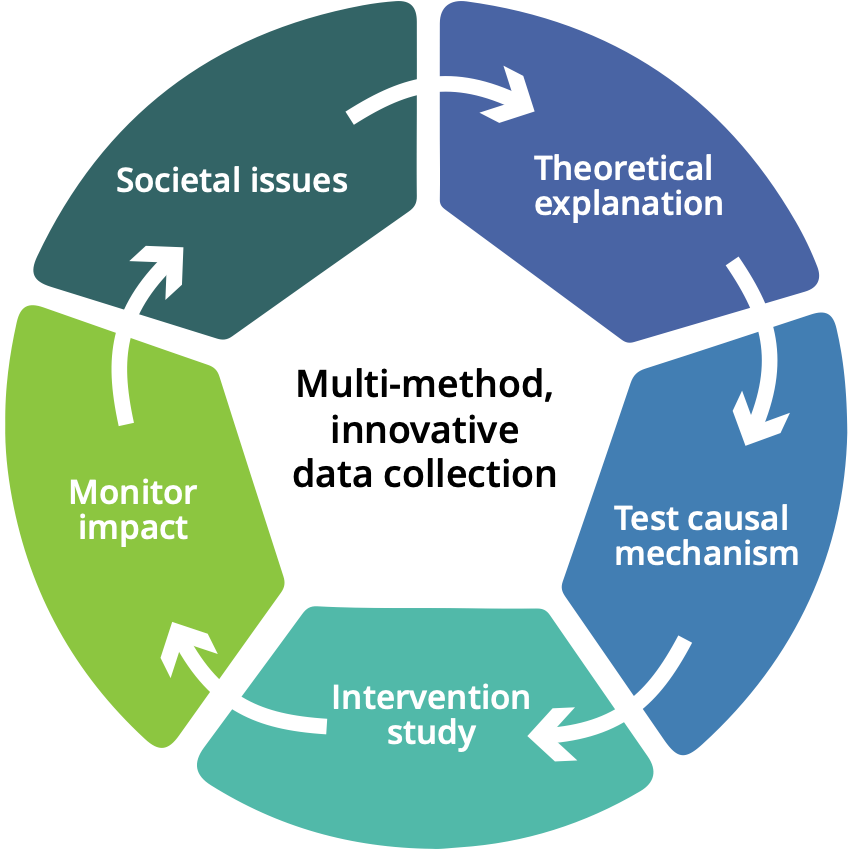
The consortium is committed to a transformative inter- and transdisciplinary approach at the forefront of international developments in social sciences and humanities. SOCION’s problem-driven approach responds to challenges to social cohesion, by facilitating integrated and reflexive knowledge co-creation.
- Identify and scrutinize societal issues and social cohesion challenges (e.g., psychological burdens or withdrawal from cooperative behaviour), utilizing real-time survey and demographic data and historic analyses of prior interventions on social relations and outcomes. Formulate concrete research questions together with academic experts and societal partners, and determine normative requirements.
- Develop theoretical explanations and identify underlying processes through:
- Test causal mechanisms using different kinds of research including agent-based modelling and laboratory experiments to examine sociological and psychological explanations for results obtained from surveys and observational studies.
- Field experiments in co-creation with societal partners to examine proof of principle for mechanisms in real-life contexts. Scale-up generalizability of experimentally established cross-level mechanisms in larger intervention studies, to develop insight into complex social cohesion. Document effectiveness across social settings, and specify context characteristics that moderate outcomes.
- Monitor relevant outcomes over time with societal partners and investigate (un)intended outcomes to allow adjustment when needed. Engage the interdisciplinary perspective and transdisciplinary evidence to generate mechanisms for the analytical toolbox.
Thematic Clusters
Inter- and Transdisciplinarity
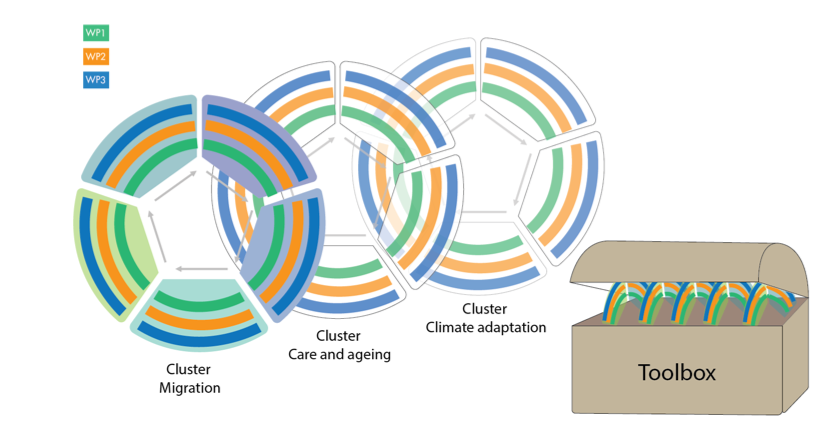
We use an inter- and transdisciplinary research strategy to investigates three pressing societal challenges: Migration, Care and Aging, an Climate Adaptation.
Our approach builds on four core principles.
- We design a dynamic, comparative approach to social cohesion that incorporates developments over time and place. Social connections may wax and wane, reshaping forms of cohesion over time.
- Not all social connections contribute to overall cohesion: they can have unintended disruptive consequences at community or societal levels. Seeking connection within like-minded groups easily induces polarization towards others. Sociological and psychological analyses expose such phenomena.
- Building new theory about cross-level social cohesion mechanisms, requires integrated input of demographers, social psychologists, and sociologists addressing interactions between individual, group, and institutional levels.
- We adopt a participatory approach to generate new insights into complex social cohesion by forming knowledge alliances with civic organizations and relevant institutions. Investigating society implies that phenomena studied emerge and change over time, continually raising additional questions.
 SOCION